MIT Engineers Pioneering Recyclable Elastic Yarn for a Sustainable Future
A breakthrough in textile recycling technology aims to combat the ever-growing issue of textile waste.

A Solving a Textile Crisis
After a closet cleanout, many individuals wonder: what options are available for recycling old threads? Regrettably, options are limited. Aside from donated clothes, traditional recycling processes for textiles simply do not exist at scale, unlike the well-established systems for bottles and cans. On average, an American tosses away about 81 pounds of clothing annually, contributing to over 11 million tons of textile waste that ultimately finds its way to landfills and incinerators. However, MIT engineers are striving to reduce this burgeoning crisis with a revolutionary recyclable yarn.

Innovative Yarn Creation
The engineering team has developed a novel yarn made from a type of plastic commonly found in milk bottles and grocery bags. This innovative yarn, which feels similar to conventional sewing thread, can be woven into stretchy, lightweight clothing designed for versatility. Researchers emphasize that at the end of its lifespan, garments made from this yarn can be melted down and transformed back into new yarn. This new yarn can then be integrated into new clothing, as well as cast into items such as buttons, belt buckles, and other plastic accessories.
Additive Recycling Capabilities
To demonstrate the yarn’s recyclability, the researchers created a spool of the innovative yarn, melted it down, and respun it into new yarn, a process that was repeated multiple times. Impressively, even after 10 cycles, the yarn maintained its strength and flexibility comparable to conventional textile threads.
Paving the Way for a Greener Future
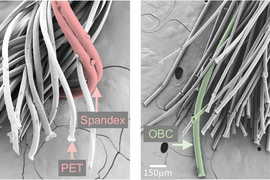
The vision for this groundbreaking yarn is to offer an eco-friendly alternative to elastic yarns currently dominating the market—namely, spandex-polyester and spandex-nylon blends, which are composed of non-recyclable fiber combinations. In stark contrast, this new yarn utilizes specific plastic materials, effectively imitating the robust and elastic qualities of spandex yarns, while ensuring ease of recycling.
“Eighty percent of textiles in the U.S. market currently consist of some amount of spandex, which renders them non-recyclable,” states Svetlana Boriskina, a research scientist at MIT’s Department of Mechanical Engineering. “There’s no widely adopted technology that currently recycles textiles back into textiles. With our new yarn, we aspire to change that.”Research and Development
Details surrounding this innovative yarn were recently published in the journal ACS Materials Letters, with key contributions from first author SeongHyeon Kim, as well as Duo Xu, Volodymyr Korolovych, Domingo Flores-Hernandez, Kaniz Moriam, and Daniel Braconnier.
The original challenges surrounding spandex stem from its chemical makeup: it is a polyurethane-based synthetic fiber that exhibits flexibility but lacks strength. Generally, a thread of elastic yarn is composed of two components: a spandex-based core enveloped by a tough polyester or nylon sheath. This combination grants elastic yarns their behavior, but unfortunately makes them highly difficult to recycle. The yarn would necessitate chemical treatment to segregate the polyester sheath from the spandex core before any recycling could occur, adding complexity and environmental concerns.

Revolutionizing Textiles with Polyethylene
In 2021, Boriskina's group introduced a novel yarn formulated from polyethylene, the most prevalent plastic globally, used in grocery bags, water bottles, and various applications. Polyethylene is a thermoplastic, allowing it to be melted down and remade into new forms, thus facilitating recycling.
Interestingly, polyethylene had not previously been explored as a textile material. The research group’s previous work illustrated successful yarn spinning from polyethylene, producing garments that showcased desirable properties such as moisture-wicking, stain resistance, and cooling capabilities.
Pushing Boundaries of Material Science
In their recent study, the focus shifted towards fine-tuning polyethylene yarn properties to replicate the strength and flexibility of spandex while demonstrating recyclability. The team investigated stretchy polyethylene-based copolymers imitating a spandex elastic core and engineers yarns acting as the sturdy outer sheath. Their research uncovered the chemical variations required to optimize the characteristics of polyethylene for textile applications.
“The chemical structure of polyethylene resembles a Christmas garland—composed of a carbon backbone with hydrogen atoms as dangling branches,” explains Boriskina. “The arrangement of these chains can significantly alter the properties of the entire structure.”
Looking Ahead
As MIT engineers finalize their innovative yarn, the potential impact of this technology is substantial. With increasing global awareness of sustainability and circular economies, recyclable elastic yarn could serve as a cornerstone innovation in the textile industry, significantly reducing waste and fostering a more sustainable future for fashion and clothing manufacturing.